
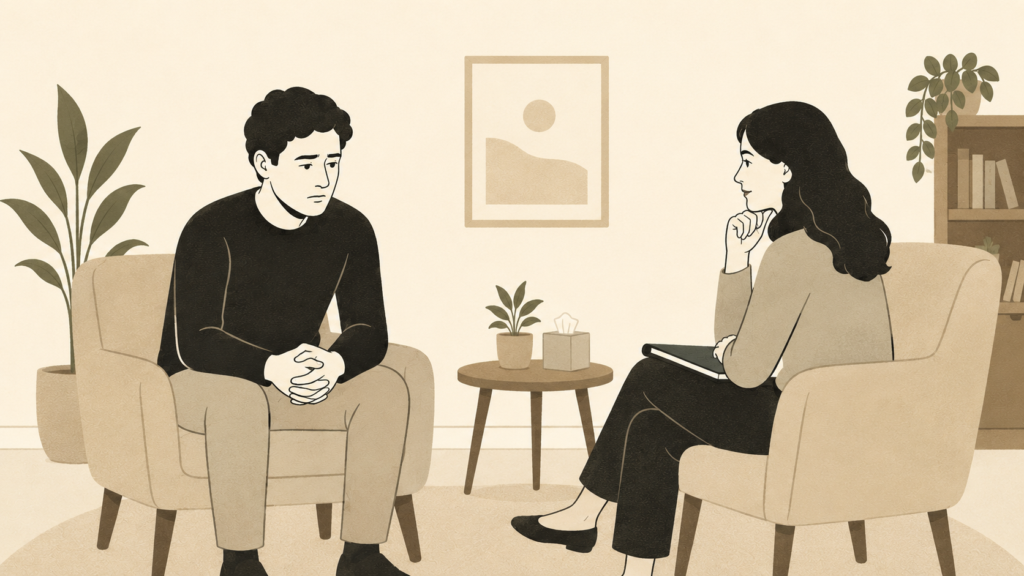


Knowing how to talk to a therapist is something almost nobody feels confident about before their first session — and many people still quietly wonder about it years into the work. There is an assumption that therapy requires a particular kind of eloquence, a talent for self-analysis, or at the very least a clear sense of what the problem actually is.
None of that is true. Therapists are trained to work with people who are uncertain, inarticulate, or in the early stages of understanding what they are even carrying. You do not need to arrive with the right words. You need to arrive.
That said, knowing a little about how the process works — what kinds of things are worth saying, what tends to hold people back, and how to get the most from the therapeutic space — can make a real difference, especially in the early sessions when the work is still finding its shape. This article is written to help you with exactly that.
Why Talking in Therapy Feels So Difficult
The Silence Before the First Session
Most people who seek counselling have spent a long time not talking about what is troubling them. They have managed, contained, and carried it — often with considerable skill. The prospect of putting it into words, to a stranger, in a room specifically designed for that purpose, can feel quietly overwhelming.
This is not a character flaw. It is a natural response to the unfamiliarity of therapeutic conversation, which operates by different rules from the social and professional exchanges that fill most of our days.
What Most People Fear Saying
The most common concerns people bring to their first session — once they feel safe enough to name them — are not about the presenting problem at all. They are about the act of speaking itself. Many people fear they will not be able to find the words. Others worry they will say something that shocks or disappoints their therapist. Some feel that if they begin, they will not be able to stop.
A skilled psychotherapist will recognise all of these fears without needing them to be named. They are familiar territory.
The Cultural Weight of Asking for Help
For many people, particularly those from cultural backgrounds where emotional difficulty is managed privately, the act of talking to a therapist carries a weight that goes beyond the practical. Counselling may feel like an admission of weakness, a disruption to family expectations, or simply something that other people do.
Understanding how to talk to a therapist is, for these individuals, inseparable from a deeper question about whether they are entitled to speak at all. The answer, always, is yes.
How to Talk to a Therapist: Practical Guidance for Every Stage
Before Your First Session
You do not need to prepare a speech, but a little quiet reflection in the days beforehand can be useful. Consider what brought you to the decision to seek support — not a polished account, just the honest shape of it. What has been difficult? For how long? What prompted you to act now rather than six months ago?
You do not need answers to these questions. Holding them lightly before you arrive is enough.
What to Say When You Do Not Know Where to Start
If you sit down and the words do not come, say that. “I’m not sure where to begin” is a perfectly complete opening. So is “I’ve been putting this off for a long time and I’m not entirely sure what I’m doing here.” A good therapist will work with whatever you bring, including the absence of a clear starting point.
The NHS guidance on talking therapies is clear that there is no single correct way to begin — the most important thing is showing up and allowing the conversation to develop.
How to Talk About Things That Feel Unspeakable
Many people carry something they have never said aloud to anyone. A past experience, a thought that frightens them, a feeling they consider unacceptable. These are precisely the things therapy is designed to hold.
If something feels too difficult to say directly, try approaching it from the outside. Describe how it affects you before you name what it is. Your therapist will not push you beyond what you are ready for — and the act of circling something, of letting a skilled counsellor know it is there, is itself a meaningful step.
How to Be Honest When Honesty Feels Risky
Therapy works in proportion to how honest you are able to be — not just about events, but about how you actually feel in the room. If a session leaves you cold, if something your therapist said landed badly, if you spent the week feeling worse after a particular exchange, these things are worth bringing back.
Many people protect their therapist from their real reactions, in much the same way they protect the people in their everyday lives. Learning to speak honestly about the therapeutic relationship itself is often where some of the most significant work happens.
How to Keep Talking When the Work Gets Hard
There will be sessions that feel raw, or flat, or stuck. The instinct in those moments is often to withdraw — to give shorter answers, to stay on the surface, to wonder whether this is worth continuing.
When the work feels hardest is usually when it most needs to continue. Naming the difficulty — “I notice I’m finding it hard to say much today” — keeps the channel open and gives your therapist something real to work with. The BACP’s guidance on getting the most from therapy highlights this kind of active participation as one of the most consistently useful things a client can bring.
What You Never Have to Say
You do not owe your therapist a performance. You do not have to be insightful, articulate, or emotionally available on any given day. You do not have to fill silence if silence is what is present. Some of the most important moments in therapy happen in the pauses between words.
What a Skilled Therapist Brings to the Conversation
Reading about how to talk to a therapist can ease the anxiety of beginning, but it cannot replicate what actually happens in the room. A skilled psychotherapist is not simply waiting for you to say the right thing — they are attending to everything: what you say, how you say it, what you avoid, what shifts in your body or your voice when certain topics arise.
This quality of attention is different from anything most people experience in daily life. It is non-judgmental not as a policy but as a genuine clinical orientation. Your counsellor has heard the full range of human experience, and nothing you bring will alter their regard for you.
Over time, the experience of being heard in this particular way — consistently, carefully, without the usual social pressures — begins to change how you relate to yourself. Many people find that the capacity to speak honestly in therapy slowly extends into the rest of their lives. That is not a side effect. It is part of what the work is for.
Your Voice Matters — Beginning Is Enough
Knowing how to talk to a therapist is not a prerequisite for starting therapy. It is something that develops through the experience of doing it — through the early hesitations, the tentative disclosures, the gradual building of trust with another person who is entirely focused on your wellbeing.
You do not need to be ready. You need to be willing.
Our directory features verified, qualified psychotherapists and counsellors across the UK, each with a detailed profile outlining their approach, areas of specialism, session fees, and current availability. Browse at your own pace, read as widely as you need to, and reach out to someone whose profile feels like a genuine fit. The first conversation does not have to be perfect. It simply has to happen. Find a therapist today.