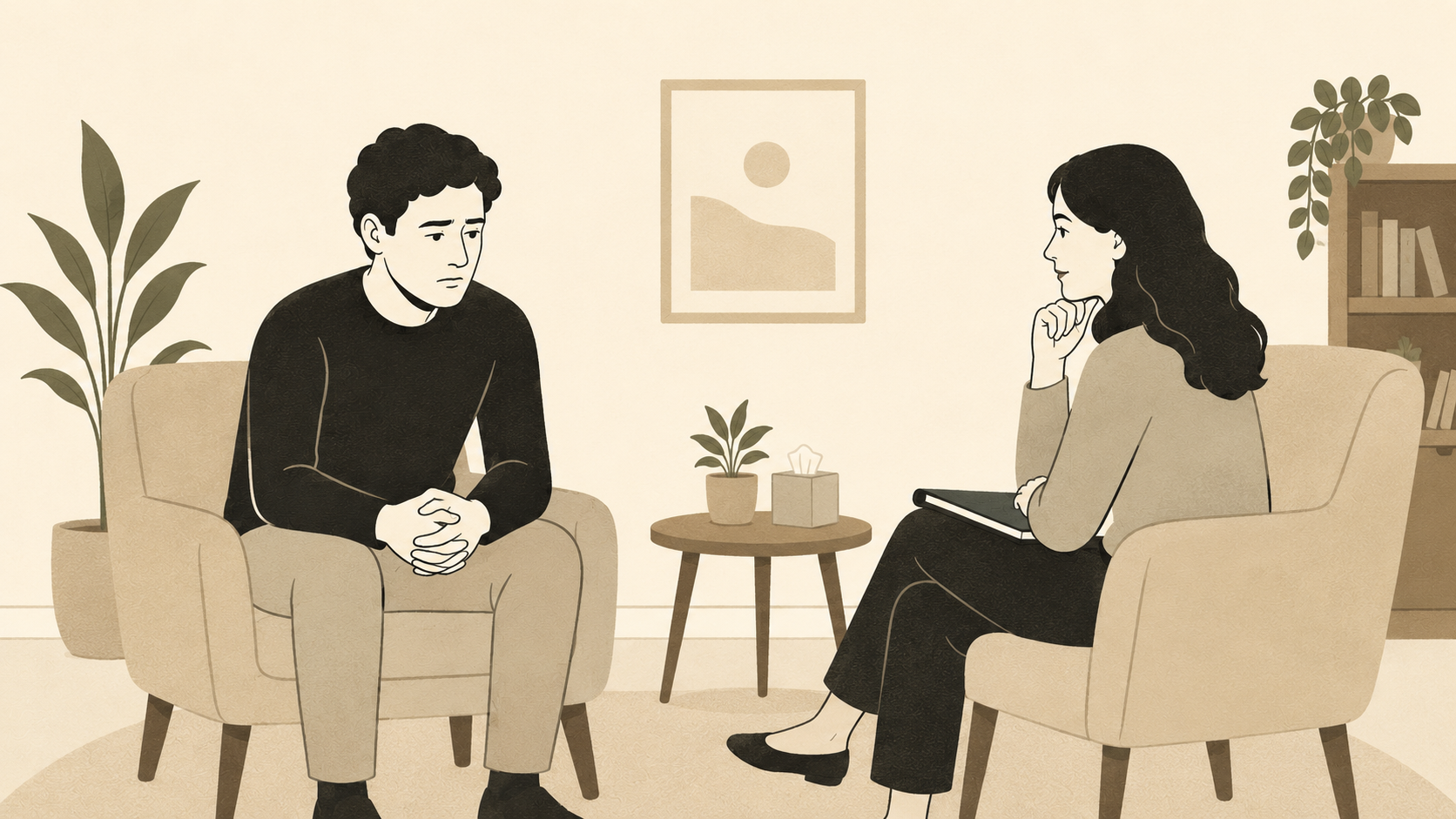


Most people do not start looking for therapy with a type of therapy in mind. They start with something that is going wrong. They cannot sleep, a relationship keeps hitting the same wall, or a memory will not leave them alone. Then they meet a list of names, CBT, psychodynamic, integrative, EMDR, and have no way of knowing which one fits.
This guide works the other way round. Find the situation that sounds most like yours, open it, and you will see which approaches are usually a good place to start, and why. It is a starting point for a conversation with a therapist, not a diagnosis, and for most difficulties more than one approach can help.
One thing matters more than any label. Research on what makes therapy work keeps returning to the relationship between you and your therapist. A good fit with a well-trained, registered therapist usually counts for more than the exact method.
Start here: what is going on for you?
Choose the description that fits best. You can open more than one.
I have panic attacks, a phobia, or worries I cannot switch off
Often a good place to start: cognitive behavioural therapy (CBT).
CBT is structured and practical. You look at the thoughts and habits that keep anxiety going and practise doing things differently, usually over a set number of sessions. The NHS describes CBT as the main talking therapy for panic disorder, and it is widely used for phobias and constant worry.
If the anxiety seems tied to older patterns, or keeps returning after short-term help, a psychodynamic or integrative therapist can help you understand where it comes from.
Read more: What is CBT?, therapy for anxiety and therapy for phobias.
I feel low, flat or stuck, and it has gone on for a while
Often a good place to start: CBT, counselling or psychodynamic therapy.
Several approaches help with depression. NICE guidance on depression includes CBT, behavioural activation, counselling and short-term psychodynamic psychotherapy among the options. Choose by what you want: practical tools to get moving again, or space to understand why you feel this way.
Read more: therapy for depression.
The same patterns keep repeating in my relationships or my life
Often a good place to start: psychodynamic, attachment-based or schema therapy.
These approaches look at how earlier experiences shape the way you relate to people now. The work is usually longer and more open-ended, and the relationship with the therapist becomes part of how change happens.
Read more: What is psychodynamic therapy?, attachment-based therapy and schema therapy.
Something frightening happened and I cannot leave it behind
Often a good place to start: trauma-focused CBT or EMDR.
If you have flashbacks, nightmares or feel constantly on edge after an event, these are the two therapies the NHS lists for PTSD. Look for a therapist with specific trauma training, not just general experience.
Read more: What is EMDR? and how to find a trauma therapist.
I had a difficult childhood and it still affects me now
Often a good place to start: longer-term relational therapy, such as psychodynamic, integrative, schema or internal family systems (IFS) therapy.
When difficulties go back a long way, the work tends to take longer and to move at your pace. A therapist experienced with complex trauma will usually focus first on feeling safe and steady before going into painful memories.
Read more: therapy for childhood trauma in adults and what is IFS therapy?
I am not sure what is wrong, I just need to talk to someone
Often a good place to start: counselling, person-centred or integrative therapy.
You do not need a clear problem to start therapy. A counsellor or integrative therapist will help you work out what is going on, and can adapt how they work once it becomes clearer.
Read more: person-centred therapy, integrative therapy and signs you might need a therapist.
Our relationship is struggling
Often a good place to start: couples therapy.
You attend together, and the focus is the relationship rather than either person on their own. It helps with frequent arguments, distance, affairs, or decisions about whether to stay together. If one of you is not ready to come, individual therapy is still worth starting.
Read more: pre-marriage counselling and therapy for divorce and separation.
Sex or intimacy has become difficult
Often a good place to start: psychosexual therapy.
Psychosexual therapists are trained specifically in sexual difficulties, for individuals and couples. Many are registered with COSRT, the professional body for sexual and relationship therapists.
Read more: psychosexual therapy explained.
Someone close to me has died
Often a good place to start: bereavement counselling.
Grief is not something to fix, and many people find their own way through it. Counselling helps when grief feels stuck, overwhelming, or complicated by how the person died or by the relationship you had with them.
Read more: prolonged grief and when to seek help.
My family keeps clashing, or I am worried about my child
Often a good place to start: family therapy, or a child and adolescent therapist.
Family therapy works with the whole family, or several members, looking at patterns between people rather than blaming one person. For a child or teenager on their own, look for a therapist trained to work with that age group.
I find it hard to put things into words
Often a good place to start: art, creative or somatic therapy.
Some people find talking difficult or feel things more in the body than in words. Art and creative therapists use making and doing, and somatic therapists pay close attention to physical sensations and the body’s stress responses.
Read more: What is somatic therapy?
I am very hard on myself, or I carry a lot of shame
Often a good place to start: compassion-focused, person-centred or psychodynamic therapy.
A harsh inner critic often has a long history. These approaches help you notice it, understand where it comes from, and treat yourself with more understanding.
Read more: compassion-focused therapy explained and therapy for low self-esteem.
Short and focused, or open-ended?
How you want to work matters as much as what you want help with. Most people lean one way.
| If you would like | Approaches that often suit |
|---|---|
| Practical tools, homework and a set number of sessions | CBT, behavioural activation, solution-focused therapy |
| Time to understand yourself, without a fixed end | Psychodynamic, psychoanalytic, attachment-based therapy |
| Someone to listen closely and follow your lead | Person-centred counselling |
| A mix, adjusted to you as things become clearer | Integrative therapy |
| Help for a specific event that is still with you | Trauma-focused CBT, EMDR |
Neither is better. Short-term work suits a clear, specific difficulty. Longer work suits patterns that go back a long way. Many people do one and later the other. Our guide to how long therapy takes goes into this in more detail.
Counsellor, psychotherapist or psychologist?
The title tells you about training, not about who will suit you. Counsellors often work shorter-term and psychotherapists more in depth, though the line is blurred in practice. Psychologists have doctoral-level training and are registered with the HCPC. Our guide to therapists, psychologists and psychiatrists explains the difference.
Whatever the title, check that the person is registered with a recognised professional body such as the BACP, UKCP, HCPC or BPC. Every therapist on The Therapist Finder has had their registration checked before their profile goes live.
When to speak to your GP or get urgent help first
Private therapy is not the right first step for everything. Speak to your GP, or get urgent help, if:
- you are thinking about ending your life or harming yourself
- you are hearing or seeing things others do not, or feel out of touch with reality
- you have an eating disorder that is affecting your physical health
- you are dependent on alcohol or drugs and may need medical support to stop
In England you can call NHS 111 and choose the mental health option, any time of day or night. The Samaritans are on 116 123, free, 24 hours a day. The NHS lists more options on its urgent mental health help page.
Using this when you search
On The Therapist Finder you can search by area of difficulty, type of therapy and location, and every profile shows the therapist’s fee. Use what you have read here to narrow the list, then speak to two or three therapists before you decide. Our checklist of questions to ask a therapist will help you get the most from those first calls.
If you are still unsure, say so. A good therapist will be glad to talk through whether their way of working suits you, and will point you elsewhere if it does not.
Find a therapist who fits
When you have an idea of what might help, search The Therapist Finder for registered, independent therapists near you or online.
Frequently asked questions
How do I know which type of therapy is right for me?
Start with what you want help with and how you would like to work. Practical, time-limited help suits a specific difficulty such as panic or a phobia. Longer, open-ended therapy suits patterns that go back a long way. Most importantly, choose a registered therapist you feel comfortable with, because the relationship matters more than the method.
Is CBT better than other types of therapy?
CBT has a lot of research behind it and suits many specific difficulties, such as panic and phobias. It is not better for everyone. For depression, NICE lists several options including counselling and short-term psychodynamic psychotherapy, and for long-standing relationship patterns many people find psychodynamic or integrative therapy more helpful.
What if I choose the wrong type of therapy?
It is not a disaster. Many therapists draw on more than one approach, and a good therapist will tell you if they think something else would suit you better. You can also change therapist. It is common and therapists expect it.
Do I need to know what type of therapy I want before I contact a therapist?
No. You can simply describe what is going on and ask how they would work with it. Their answer will tell you a lot about whether they are the right person.